
Community members plead with San Diego Sheriff to stop turning over people to ICE

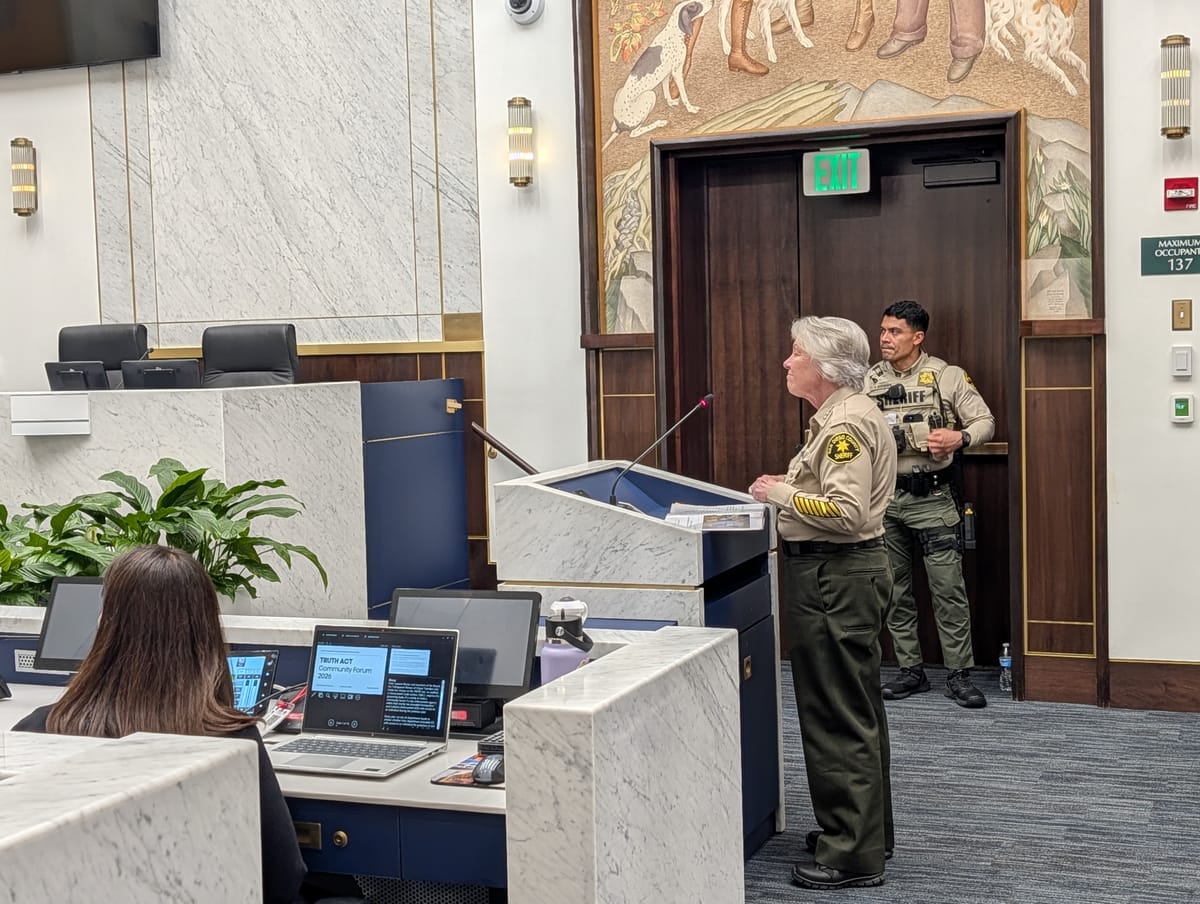
At the annual TRUTH Act forum, San Diego Sheriff Kelly Martinez maintained her position that she doesn't have to follow the county's ordinance on the issue because she is an elected official.
Written by Kate Morrissey, Edited by Lauren J. Mapp
Community members pleaded with Sheriff Kelly Martinez last week to stop transferring people from jail custody to Immigration and Customs Enforcement.
In January, the county supervisors passed an ordinance that requires officials, including ICE officers, to present judicial warrants in order to arrest someone in a non-public area owned by the county. Martinez said she doesn't have to follow the ordinance when it comes to transfers to ICE because she is an independently elected official and has the right to determine jail policies without the Board of Supervisors getting involved.
At an annual meeting about the sheriff's interactions with and transfers to ICE, dozens of community members voiced their concerns about the continued cooperation. The meeting is a requirement of the TRUTH Act, short for Transparent Review of Unjust Transfers and Holds, one of three California laws that govern how local law enforcement can interact with federal immigration officials.
“The sheriff talked about making our community safe, but this makes our communities unsafe,” said Alondra Alvarez with Universidad Popular in North County.
Alvarez pointed to a recent killing in Fallbrook in which a White man said he had friends in law enforcement before killing a Latino man and wounding another.
Martinez repeated herself throughout the two-hour meeting, saying that only she had the ability to set policies involving ICE transfers.
“As sheriff, I set the policy of our detention facilities, and it's always been my belief that it is safer to conduct legal immigration transfers within state statutes to avoid disruptions and ripple effects taking place in our communities and having bystanders taken in as collateral as part of federal immigration enforcement,” Martinez said.
“My policy is based on enforcement as well as prevention, not politics,” she added.
The two Republican supervisors did not fully participate in the meeting. Supervisor Joel Anderson was not present at all, and Supervisor Jim Desmond left partway through.
The meeting began with a presentation from the sheriff about transfers from jail custody to ICE in 2025.
"As your sheriff, I must balance legal obligations and my foremost priority which is public safety,” Martinez began. “The Sheriff's office is tasked with protecting every resident, regardless of immigration status, from crime, violence and harm. I recognize that fears exist, and we are committed to transparency, lawful conduct and policies that keep our community safe.”
In 2025, the sheriff's office received 1,082 requests from ICE officers for the jail to hold people until immigration officials could pick them up, Martinez said. That's down from 1,236 the year before.
Martinez said her office ultimately transferred 83 people to ICE. That's almost three times the number from the previous year, when the sheriff transferred 30 people.
Martinez said her office received federal judicial warrants from ICE for 53 of the people transferred in 2025, and the other 30 had criminal convictions that she said allowed her to make the transfers.

California law prohibits the sheriff from holding people for longer than they would otherwise be held, but it does allow Martinez to provide ICE with information about the release dates of people who have committed certain crimes, she said.
ICE officers requested to interview four people in the Sheriff's custody last year. Two agreed to the interviews, and two declined, Martinez said.
Then the board asked randomly selected, pre-submitted questions from community members. Many asked about how the sheriff's office determines whether someone is an immigrant to be handed over to ICE. Martinez said her office doesn't ask about immigration status, and any country of origin information is self-reported. Notably, several people transferred to ICE in 2025 told her office they were U.S. citizens.
Many of the questions urged her to follow the county's ordinance that would prevent her from transferring anyone to ICE.
Martinez answered most questions by reading from prepared remarks in a binder.
Martinez did not directly answer some of the questions and even directed the question asker to submit a public records request in a few instances.
“That is quite offensive to the community for not providing concrete answers to our questions,” Patricia Mondragon of Alliance San Diego told the board later in the meeting.
During the public comment period, all but a few were there to push the sheriff to change her practices to line up with the county rules.
One woman who goes by Cuban Memee said that sheriff deputies detained her nephew for having tinted windows on his car last year. After deputies called her family to say someone could pick him up, the family waited for him at the jail only for deputies to transfer him directly to ICE. The agency later deported her nephew, who is from Cuba, to Mexico, she said.
“My nephew looks just like me, Afro-Black, in the middle of nowhere, where he's being easily recognizable,” Memee said. “It's really hard to understand how is the sheriff, in my eyes, able to violate that and get away with what they did. I'm representing those who don't have a voice, those who are now deceased in the custody of all these detention facilities. It's very painful.”
Toward the end, supervisors asked Martinez to estimate how much of her staff time goes into ICE transfers or responding to other ICE requests.
“We heard this question over and over. Your office is using technically county-funded staff time and resources to screen individuals, issue notifications, coordinate with federal agencies and facilitate transfers,” Supervisor Paloma Aguirre said. “Can you provide a clear accounting of the total public funds for these activities in 2025?”
Martinez did not commit to figuring out that statistic but said she would look into how much staff resources it would take to make the calculation. She voiced concern at the potential use of resources to make such a calculation.
As the meeting wound down, Supervisor Terra Lawson Remer questioned Martinez about another issue related to ICE — who investigates rape allegations at Otay Mesa Detention Center, which is run by private prison company CoreCivic and holds people in ICE custody. CalMatters reported Thursday that a memorandum of understanding exists between the sheriff and CoreCivic that says the warden has the authority to decide whether to investigate rape allegations at the facility.
The sheriff suggested she would need more funding for more staff in order to handle the amount of complaints that might come out of the facility.