Deported father returns to Oceanside after months in Mexico

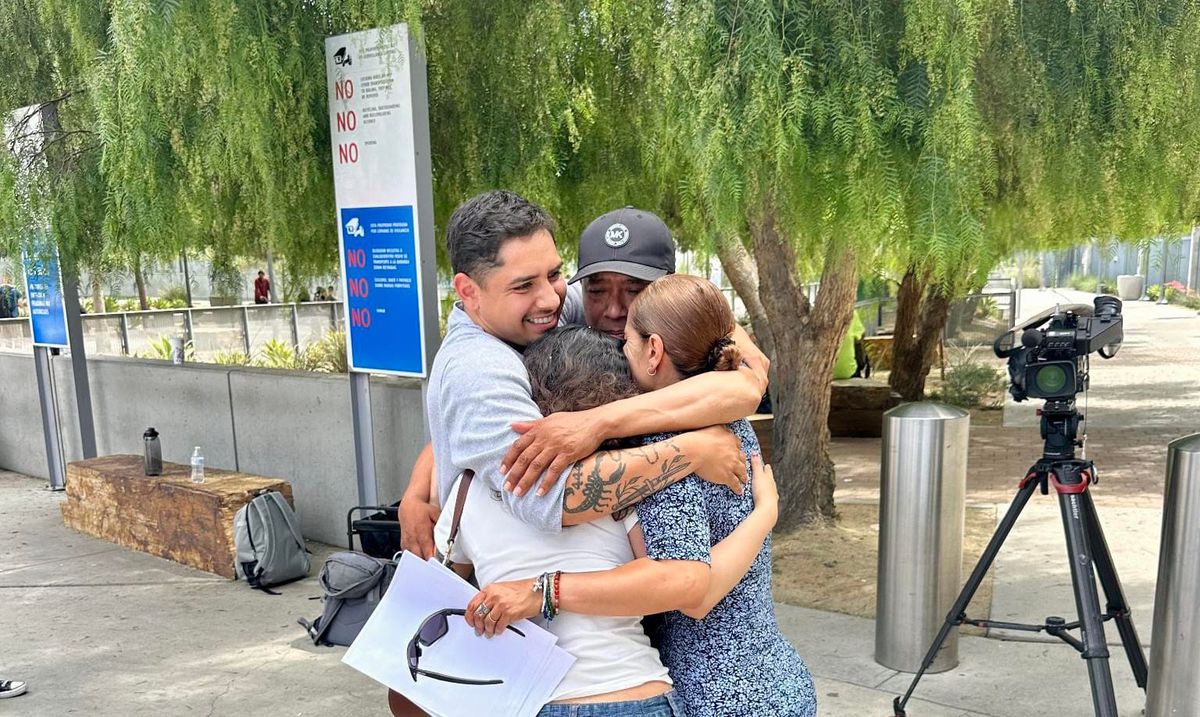
ICE deported Esteban Rios Sosa despite his having a pending visa application for people who are victims of crimes that had advanced enough through the process that the government had given him protection from deportation.
Written by Kate Morrissey, Edited by Lauren J. Mapp
A deported father recently returned to his family in Oceanside after a federal judge intervened in his case.
Esteban Rios Sosa crossed north at the San Ysidro Port of Entry on Sept. 10, where hugs and big smiles from his family greeted him after nearly a year in Mexico. Immigration and Customs Enforcement detained Rios Sosa and his wife when they were trying to enter Camp Pendleton to visit their pregnant daughter whose husband was in the U.S. Marine Corps.
“It was a very emotional, very happy moment,” Rios Sosa recalled in Spanish of his first steps back into the United States. “It hasn't been easy, but in the end, we did it. I'm very grateful.”

ICE did not respond to a request for comment about his case.
Rios Sosa and his wife had visited their daughter on base about 10 times before without issue, according to court documents in the federal case to return the father to the U.S. But, on Sept. 28, 2025, the couple, accompanied by their son who was also in the Marines, found themselves stopped at the gate and told to wait for ICE.
The couple explained that both had deferred action protecting them from deportation because of a visa application for victims of violent crimes. Both had REAL IDs and work permits.
Rios Sosa said that the officials said they had to go with ICE to the downtown office anyway, and the family waited hours for ICE to come to the gate to get them.
Since Camp Pendleton announced a joint initiative with ICE in May 2025, officials at its gates have detained dozens of immigrants.
That day, Rios Sosa and his wife ended up leaving the ICE office with ankle monitors and an appointment to come back in a couple of weeks. When they returned, ICE had decided to detain just about everyone who came for check-in appointments.
While Rios Sosa's wife went to an immigration detention facility, where an immigration judge later freed her, ICE deported the father within a day of detaining him. He waited a few weeks in Tijuana to find out what would happen to his wife, and once ICE released her from Otay Mesa Detention Center, he traveled to his hometown in Veracruz.
He said he worried about his safety in both Tijuana and Veracruz.
“If you come from here, even if you're deported, people think you have money, and they'll kidnap you,” Rios Sosa said. “I didn't leave the house much because I was afraid that I would be kidnapped.”
He found a little work, but his family sent money to support him so he wouldn't have to put himself at risk, he said.
He said he spent most of his time there depressed.
“To be honest, I didn't have a lot of hope,” Rios Sosa recalled.
After he spoke with Monika Langarica, an attorney with the Center for Human Rights and Constitutional Law, he said, he felt more hopeful. The organization was fighting in court to help detained and deported people who had received bonafide determinations for U visas, meaning U.S. Citizenship and Immigration Services had done a preliminary review of their visa applications as crime victims and issued work permits and deferred action to protect them from deportation while they waited in the years-long line to receive the actual visas.

Langarica and her team filed a habeas corpus case to challenge his detention, and on Sept. 8, federal Judge Janis L. Sammartino ruled in Rios Sosa's favor.
He was teaching softball to a girl in Veracruz when he got the news. Cell service wasn't good on the ballfield, so someone came running to tell him to call his family, he said.
“I was thinking the worst, that an accident or something had happened, but then my wife and the attorney said we'd been approved,” Rios Sosa said. “I began to cry. I was very happy, truly — feelings that I can’t describe with words — waiting and hoping so much for that, and when it comes, you shake, you want to cry, and you know you're a step closer to seeing your family and returning to normal life, the life that you've had here.”
He crossed the border two days later.
At the port of entry, officials held him for a time while Langarica explained that she had a federal order for his return.
Now he's returned to cleaning cars at an auto detail business, and he's getting to know his new grandchild. Both his son and son-in-law have left the military, Langarica said.
People whose family members are detained or deported after applying for U visas can contact the Center for Human Rights and Constitutional Law at icwc_classcounsel@centerforhumanrights.org about their cases for potential support, Langarica said.