San Diego turns off Flock automated license plate readers


The police department said it would work with the vendor to remove the cameras after a unanimous City Council vote.
Written by Kate Morrissey, Edited by Lauren J. Mapp
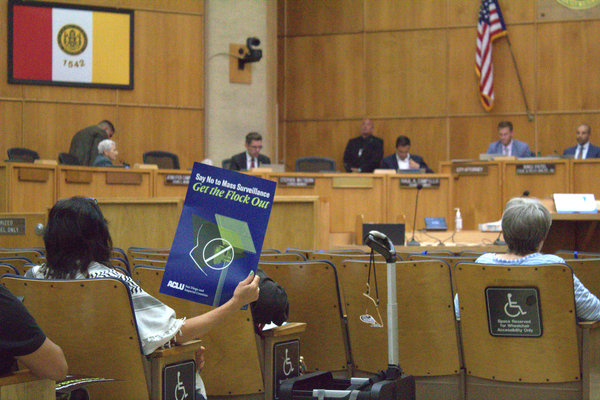
The San Diego Police Department turned off its automated license plate reader cameras Tuesday night after the City Council voted to end its use of the surveillance technology.
With two councilmembers absent, the City Council made a unanimous decision Monday after learning that police had used the technology to surveil a domestic violence survivor as part of an internal investigation. The department said that it cut off all officers’ access to the system starting around noon on Tuesday.
“There have been multiple breakdowns of trust by SDPD when it comes to the use of this technology,” Councilmember Henry Foster III said before the vote.

Referencing several local cases in which police wrongfully arrested people because of inaccurate information from the plate readers and a case in which police shot a 19-year-old after the technology mistakenly said the car he was in was stolen, Foster said the surveillance system had long needed more accountability.
“We should not have to choose between public safety, civil liberties and the right to privacy,” Foster said. “San Diegans deserve them all.”
Ubicquia, one of the companies involved in San Diego's automated license plate reader and smart streetlight system, did not respond to requests for comment.
Andrew Smith, a spokesperson for Flock Safety, said the company respects the city's decision and insisted that the technology improves safety.
“The San Diego Police Department has solved countless crimes and made a measurable public safety impact with Flock technology,” Smith said via email. “When a tool that is actively helping solve violent crimes is removed, public safety moves backward.”
In an emailed statement, San Diego's Police Chief Scott Wahl thanked San Diegans for participating in the conversation.
“I want to acknowledge the work that our teams have put in over the years on these technologies,” Wahl said. “Our officers and detectives will continue to provide the highest quality service when investigating crimes throughout our city.”
The vote comes after a long fight from community members and organizations to end the use of automated license plate readers. In the aftermath of an attack on the Islamic Center of San Diego, many Muslim community members pushed back on the department's use of the moment to tout the technology. And more recently, several organizations sued to end the city's use of the surveillance system.
Some council members, including Foster, Sean Elo-Rivera and Vivian Moreno, had long opposed the technology's use and pushed alongside community voices to end the Flock contract.
“That's the thing that I find most dangerous about this, and it's the false confidence that the technology produces,” Elo-Rivera said during the meeting, “and a tool that treats people as guilty until proven innocent doesn't make anyone safer.”
He emphasized that police had lost community trust because of the automated license plate readers.
“This was never a fight over whether San Diegans should be safe,” Elo-Rivera said. “It was a fight over how safety's a universal right. It's a deeply personal feeling, and it depends on one thing above all else, and that's trust. And, trust requires honesty and transparency, and when those things are missing, people stop feeling safe.”
Other council members acknowledged that they had previously supported the technology, but decided to change over community concerns about federal immigration operations or the recent revelation about the domestic violence survivor.
“My view of the effectiveness of ALPRs hasn't changed,” said Councilmember Stephen Whitburn. “What has changed is the context.”
He said the Trump administration's targeting of immigrant communities had turned parts of the U.S. into a police state, and even though Whitburn didn't believe that San Diego license plate reader data was reaching Immigration and Customs Enforcement, he believed getting rid of the cameras would alleviate a little bit of families’ anxiety over the issue.
“The city's Flock cameras have been up for less than three years,” Whitburn said. “San Diego has been one of the safest cities in America for decades.”

The City Council also voted to stop using the smart streetlight surveillance system.
Public comment — mostly in opposition to the Flock Safety cameras — went on for hours on Monday. The room cheered when the council members cast their votes to turn off the technology.
Foster said he worried that police would still access the system after the vote because he'd heard about that happening in other cities. He called for the removal of the cameras.
Kohta Zaiser, city council affairs advisor for the mayor's office, assured Foster that the mayor intended to follow the council's directions and instruct San Diego police to work with vendors Flock Safety and Ubiquia to remove the cameras. Zaiser said that the contract includes a provision that the city would not have to pay for camera removal.
Ashley Nicholes, communications manager for the San Diego Police Department, noted via email to Daylight San Diego on Wednesday that the cameras are still in place and said the department plans to inform the mayor's office of the removal schedule by the end of the week.
She said the department is working with the vendor to delete the data.