Islamic Center of San Diego welcomes visitors for Open Mosque Day

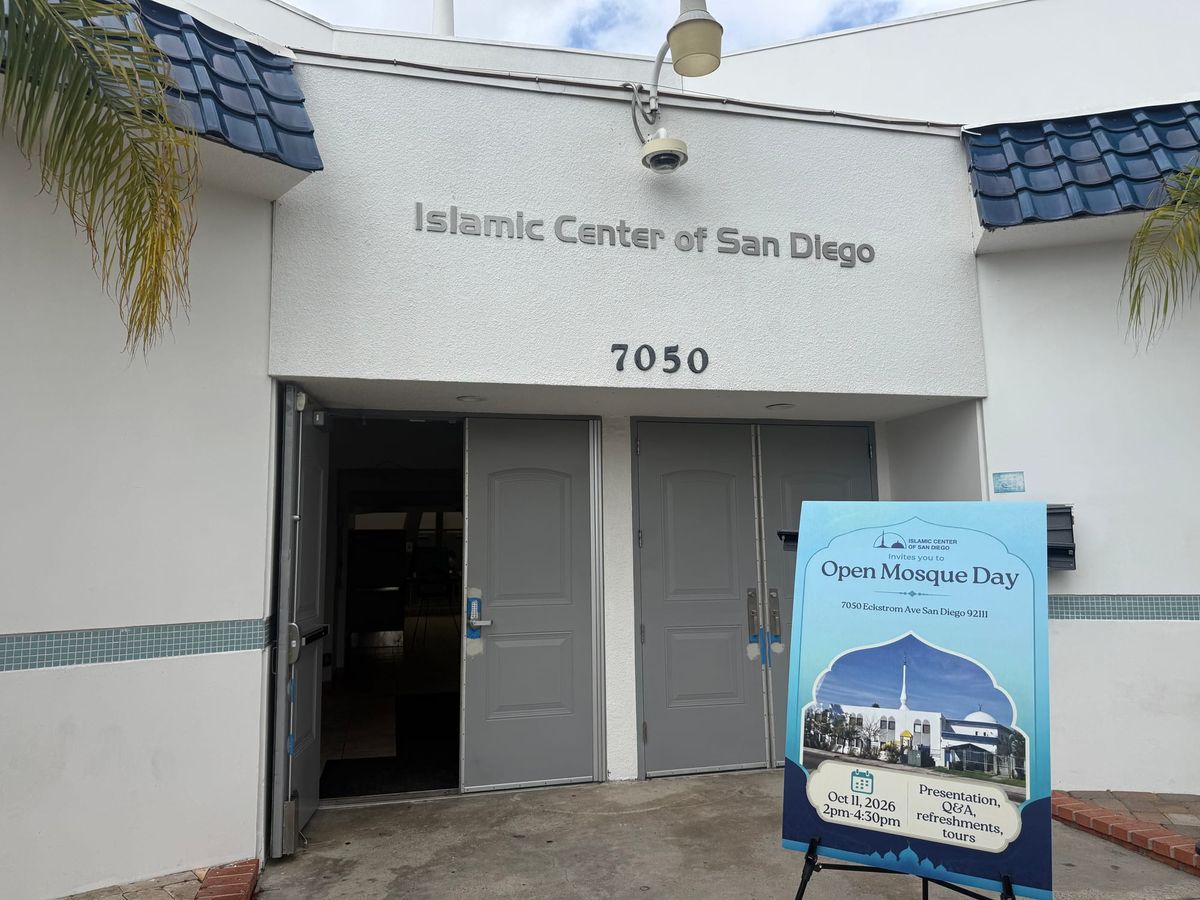
Visitors toured the mosque and learned about Islamic beliefs and practices to strengthen connections between the Muslim community and other San Diego residents.
Written by Emma Chen, Edited by Kate Morrissey
Five months after an act of domestic terrorism claimed the lives of three members of San Diego's Muslim community, the Islamic Center of San Diego opened its doors to the public for tours and to answer questions about the religion.
On Oct. 11, around 40 visitors gathered at the center in Clairemont for its annual Open Mosque Day, which featured guided tours of the mosque, an educational presentation and discussion with members of the Muslim community.
“Our primary goal is education,” said Naqi Elmi, director of the center’s outreach program. “Education of whom? Education of anybody who is interested to learn about Islam.”

Elmi said the event reflected the community's commitment to maintaining connections with San Diego residents despite the attack.
“These kinds of cowardly acts will not deter us,” Elmi said in an interview with Daylight San Diego. “The community is very resilient.”
Elmi also thanked San Diego residents for their support following the shooting. He recalled a gathering at a nearby park shortly after the attack, where he estimated that thousands of people, including community leaders, local officials and business owners, came together to express solidarity.
Elmi said that the center has continued to welcome worshippers and has even experienced increased attendance at some of its regular activities.
During Open Mosque Day, visitors walked through the mosque’s spacious two-story prayer hall, where patterned carpets covered the floor. As guests explored the building, guides said Muslims use the prayer hall for daily worship, and the mosque serves as a gathering place for San Diego’s Muslim community.
Elmi said workers began building the center in 1984, initially completing its prayer hall to provide a space for congregational worship. By 1986, it had finished the remaining facilities. Today, the Islamic Center of San Diego hosts daily prayers, educational programs, community events and a full-time pre-K through third grade school.
Following the tour, visitors took their seats around round tables arranged to face the front of a conference room where Elmi led an interactive presentation on Islamic beliefs and traditions. Throughout the presentation, Elmi posed multiple-choice questions and encouraged attendees to share their answers, turning the session into a conversation rather than a traditional lecture.
Among the questions, Elmi asked attendees what percentage of Muslims worldwide are Arab. Visitors offered several guesses, including 20%, 30% and 50%.
Elmi said that Arab people account for approximately 20% of the global Muslim population, challenging the common assumption that most Muslims come from the Middle East.
He said the Five Pillars of Islam form the foundation of Muslim religious practices. Those include charitable giving and fasting during Ramadan.
With more than 20 years of experience in Islamic outreach and education, Elmi said he hopes programs like Open Mosque Day encourage visitors to seek information directly from Muslim communities rather than rely on misconceptions.
During this year’s presentation, Elmi said the Quran, Islam’s holy book, plays an important role in guiding Muslims’ beliefs and daily practices. He said he chose to focus on the Quran partly in response to incidents involving people burning copies of the holy book.
He encouraged visitors to learn about the text's significance to Muslims and offered complimentary copies and educational materials to those interested.
During the question-and-answer session, attendees raised topics ranging from Islamic beliefs and religious practices to discrimination, international conflicts and the Muslim community's place in American society.
One attendee questioned why Islamic traditions separate men and women during prayer.
Elmi said the practice allows worshippers to focus on prayer without distractions. He said the Islamic Center of San Diego provides a separate prayer area for women on the second floor.
Another visitor raised concerns about the humanitarian crises in Gaza and Sudan, questioning how Muslim organizations respond to international conflicts.
Elmi said the center supports fundraising efforts and works with humanitarian relief organizations to provide financial assistance to affected communities.
In an interview with Daylight, Elmi said the conversations reflected broader concerns about the current social and political climate, particularly following the May attack.
He said that maintaining relationships with people outside the Muslim community is especially important during difficult times.
Beyond Open Mosque Day, the Islamic Center of San Diego offers introductory classes about Islam every Sunday from noon to 1 p.m., along with discussions that explore specific topics in greater detail. The center also conducts educational outreach at churches, universities and schools throughout the region to dispel myths and help non-Muslims feel more connected to their Muslim neighbors.
Elmi said these programs allow people to continue asking questions and learning beyond a single afternoon.
He emphasized that the support the Muslim community received following the shooting reinforced his belief that the actions of a few individuals do not represent the broader public’s opinion.