San Diego Climate Week starts at the water — with hazmat suits

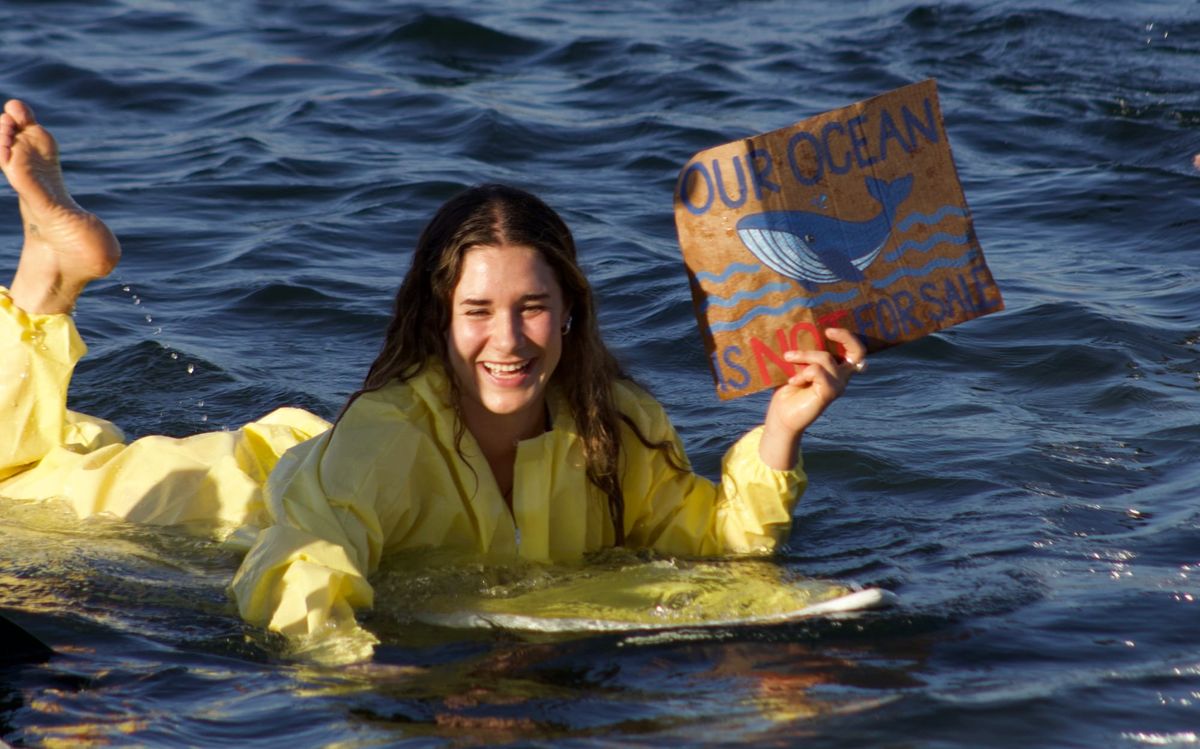
Paddlers in hazmat suits opened San Diego Climate Week in Coronado, where advocates and regional leaders called attention to the Tijuana River pollution crisis and the need for binational solutions.
Written by Yanelli Zavina Robles, Edited by Kate Morrissey
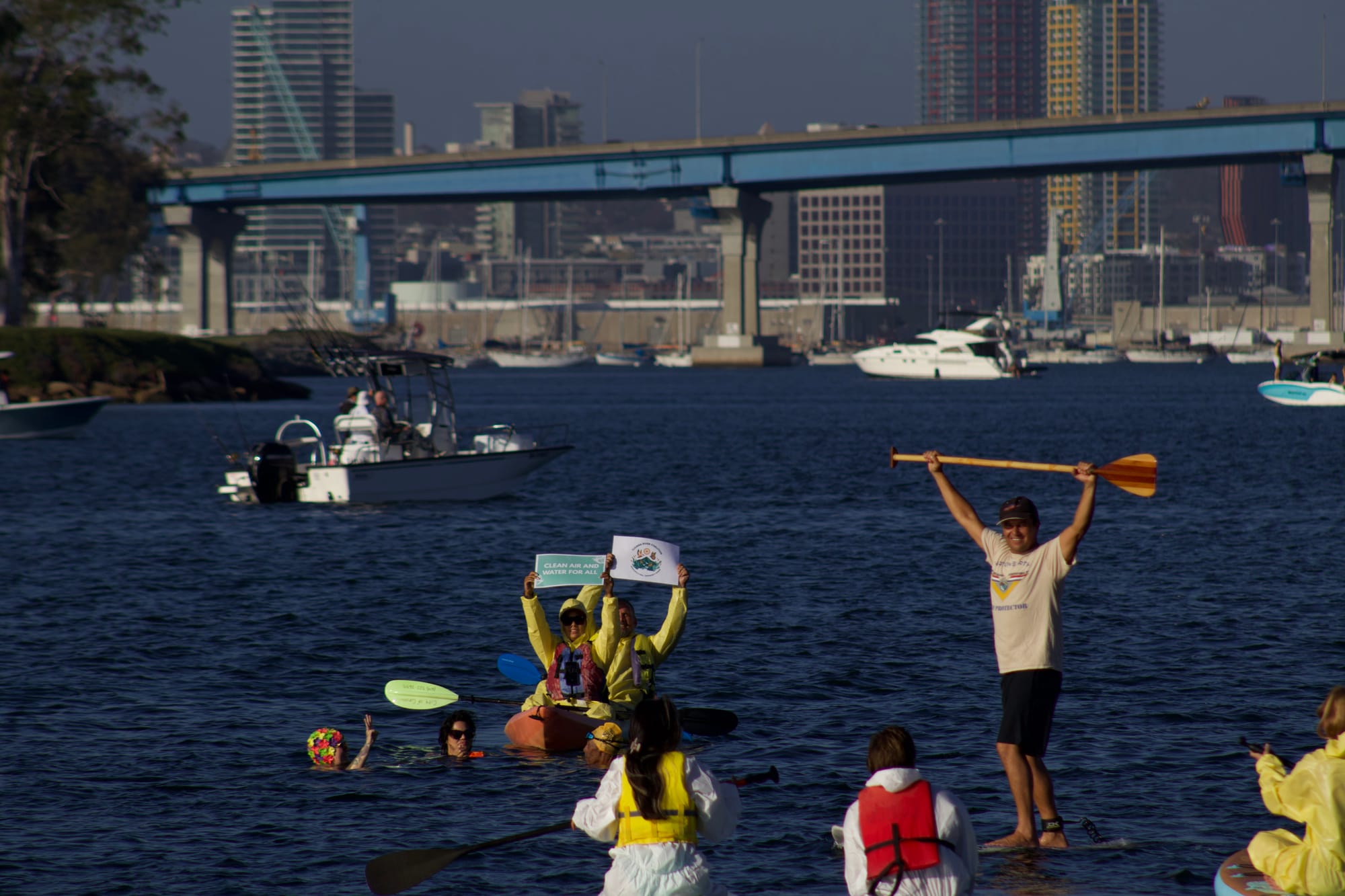
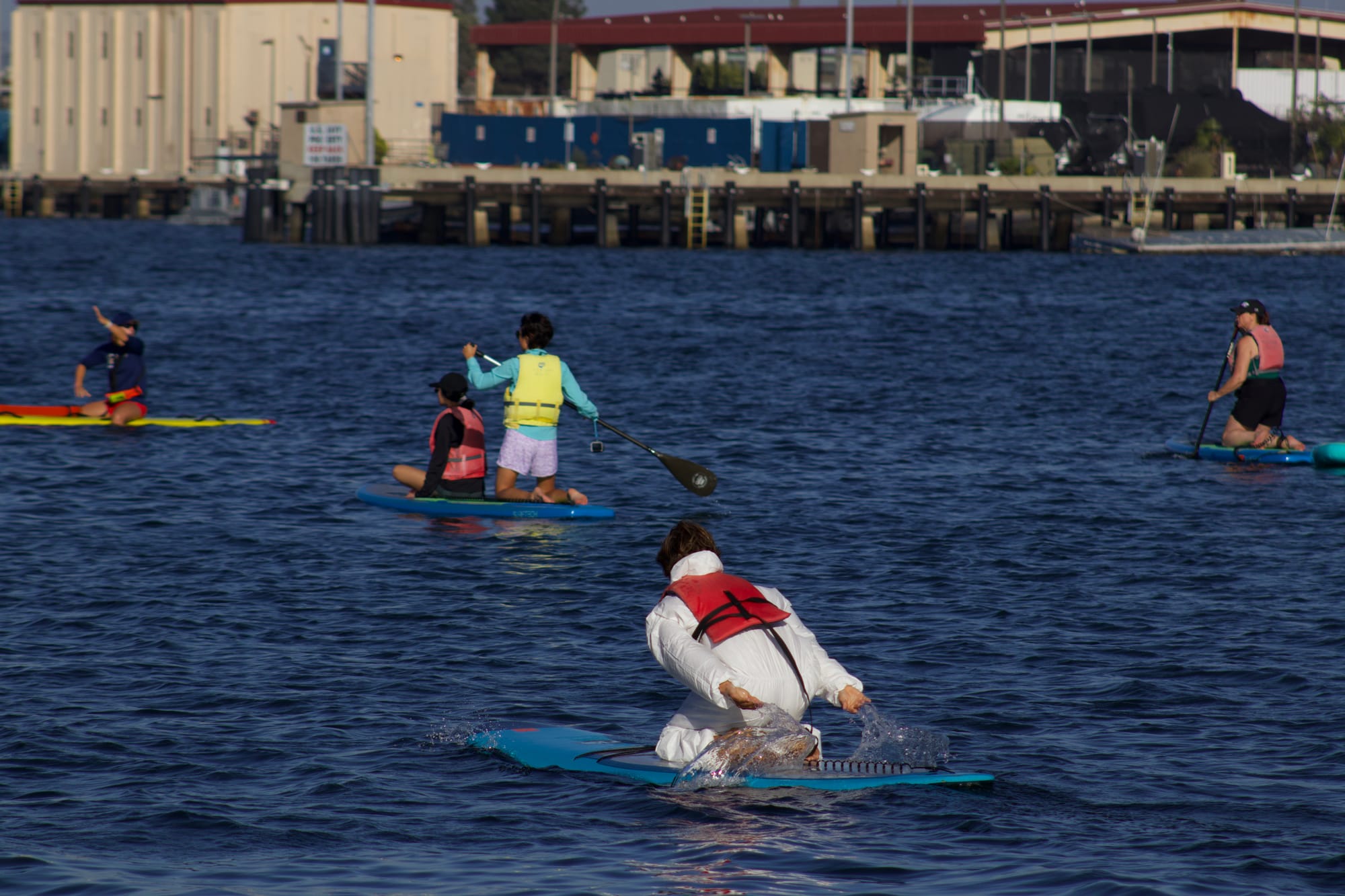
Paddlers in hazmat suits took to the waters of Glorietta Bay in Coronado as community members and environmental advocates gathered along the shoreline to call attention to the need for clean water and the ongoing Tijuana River sewage crisis.
The ceremonial paddle out on Oct. 1 marked the opening of San Diego Climate Week, bringing together representatives from WILDCOAST, Paddle for Peace, 4 Walls International and Sierra Club San Diego to advocate for clean water and air in communities impacted by cross-border pollution. This year’s Climate Week included more than 200 events across the region, including events on both sides of the U.S.-Mexico border.
The paddle out set the stage for the Water Summit, a panel that brought together people who have worked on the Tijuana River sewage crisis from different areas — advocacy, public health, environmental protection and cross-border efforts.
“Our goal is to diversify the coast for our future generations, and it’s imperative that we have clean water for them to heal and connect to,” said Aiyana Reissman with Paddle for Peace. “There’s no point in bringing them here if they can’t go in.”

Earlier that morning, Meg Ferrigno, co-chair of San Diego Climate Week, joined a tour of the Tijuana River Valley run by the Tijuana River Coalition, Sierra Club San Diego and 4 Walls International that took participants to sewage treatment facilities for a firsthand look at the infrastructure involved in addressing cross-border pollution.
Ferrigno explained the tour was intended to help people better understand conditions in the Tijuana River Valley and what they would be voting on with Measure B in November.
Measure B, also known as the San Diego County Health & Safety Act, would establish a countywide half-cent sales tax. If approved, 22.5% of the revenue would be directed toward the Tijuana River sewage crisis, with at least 20% of total revenue required to go toward projects designed to stop sewage flows.
During the Water Summit, leaders from government, environmental organizations and Indigenous communities said the Tijuana River sewage crisis has affected public health, the environment and surrounding communities, and they outlined potential solutions.
Moderated by WILDCOAST Executive Director Serge Dedina, the panel connected the pollution crisis to public health, economic impacts and communities’ cultural and spiritual relationships with the region’s waterways.
Phillip Musegaas, executive director of San Diego Coastkeeper, said his organization began monthly monitoring at four locations in the Tijuana River Estuary about a year and a half ago, testing for bacteria and roughly 100 chemicals commonly associated with industrial manufacturing.
He said that more than two dozen industrial chemicals — and sometimes as many as 30 — are detected in nearly every sample.
“The fact that we’re finding them on a continuous basis in the Tijuana River is a huge wake-up call,” Musegaas said. “This is not just a surfing problem or a beach problem. This is a public health crisis.”
A surfer who moved to Imperial Beach in 2001, San Diego County Supervisor Paloma Aguirre said losing the ability to safely enjoy the ocean can take a toll on people whose lives are closely connected to the coast.
“Somebody who bases their entire identity on being a surfer in the ocean and the ability to enjoy nature — it’s embedded in your DNA — and to have that taken away is just completely devastating for your mental health,” Aguirre said.
Aguirre emphasized the crisis has expanded beyond whether residents can safely access beaches, pointing to concerns about air quality and the physical and mental health of surrounding communities.
“It’s not just the coastal access issue, but now you don’t even know if just going to the grocery store down the street, if you’re going to get sick from breathing in the air,” Aguirre said. “So we know that the impacts, the health impacts, are vast.”
Aguirre also cited preliminary findings from an economic impact study estimating between $125.6 million and $503.5 million in annual regional losses and nearly $8 billion in cumulative losses due to the sewage crisis.
Kumeyaay leader Bobby Wallace said the damage to the river also carries a cultural and spiritual loss.
“It’s a living being that my people have traveled on since the beginning, since our creation,” Wallace said of the river.
Wallace said when he visited the river, he struggled to breathe as he walked through the area. He said that there is a psychological toll on parents raising children in communities affected by the pollution.
“You see the little babies being born down there, and it’s horrible because they have to be brought into this world, into something they’re not supposed to be breathing,” Wallace said. “And it’s psychological for the parents trying to ponder what to do for their little kids.”
As the discussion moved toward accountability, state Sen. Steve Padilla said policymakers are looking for ways to address industrial pollution entering the watershed from manufacturing operations in Mexico, including those connected to companies doing business in California.
“Every tool we can bring to bear to get corporate actors to do the right thing and not just locate on that side of the border to help continue exacerbating an environmental disaster, we absolutely need to do that,” Padilla said.
Octavio Lopez, Nación Verde founder and CEO, said during the panel that restoration is going to take years but can be achieved with effort on both sides of the border.
“The environment really, in some things, knows no boundaries,” Lopez said.
Lopez said that restoration efforts must include communities living along the watershed and give residents a reason to believe the river can recover.
“People in Mexico, in Tijuana, they just don’t believe the river can be something else,” Lopez said. “But we’re beginning to see that shift because the conversation is raised.”
Restoration can take years, Lopez said, calling for larger-scale efforts that incorporate vegetation, wetlands and other natural approaches throughout the watershed.
“It has to be done binationally, and it has to be done also at scale,” Lopez said.
When San Diego Climate Week first launched last year, organizers had to do a lot of explaining about what it was, according to Erika Rodriguez, co-founder and co-chair of San Diego Climate Week.
This year, Rodriguez noticed a shift.
“It was more of, ‘Oh, we’re ready for this. We’ve got our events planned. We’ve been thinking about it,’” she said. “People had it already on their calendar and were ready to collaborate and come together to talk about climate.”
Rodriguez hopes that momentum will establish Climate Week as an annual San Diego event that draws people from outside the region while showcasing local environmental work and that San Diegans will feel inspired to work together on issues like the Tijuana River sewage crisis year round.