
Woman recalls medical emergencies, low food quality and retaliation in ICE custody

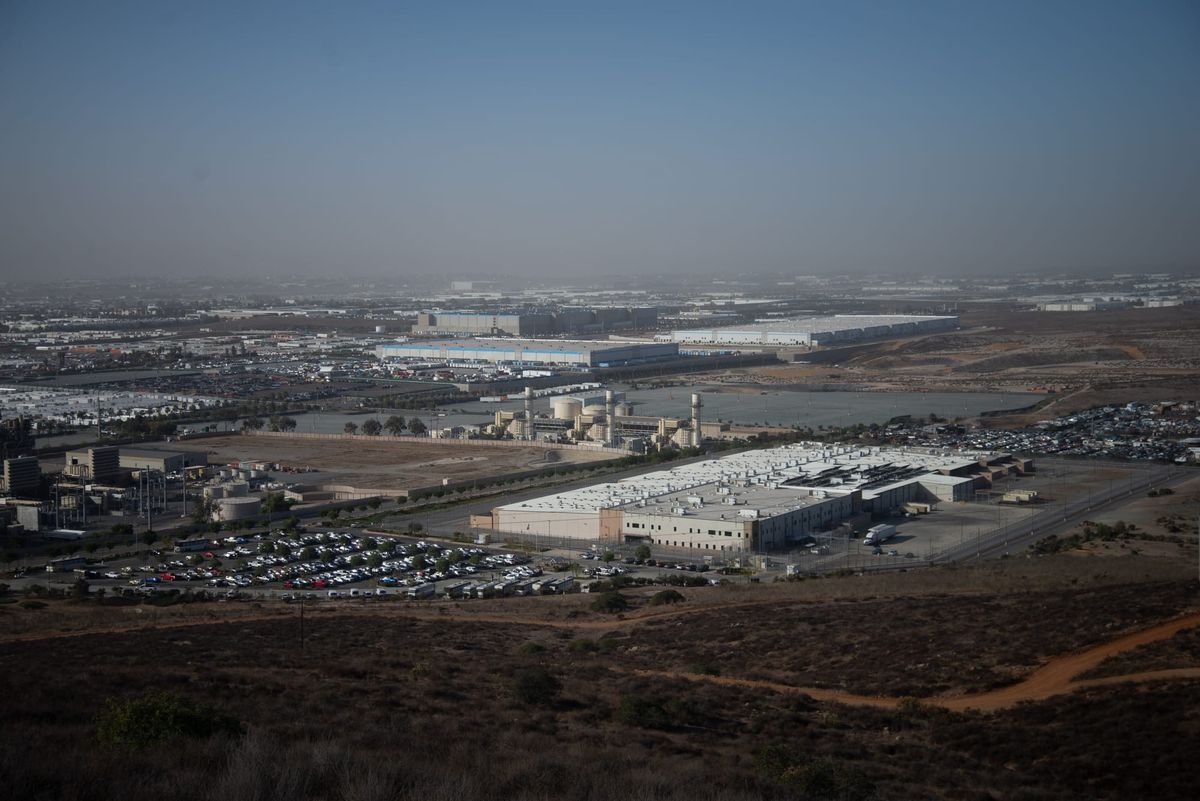
As San Diego County sued to gain access to Otay Mesa Detention Center for its health inspectors and county supervisors, a woman recently released from custody there described the conditions as terrible.
Written by Kate Morrissey, Edited by Lauren J. Mapp
Updated on May 6, 2026 at 3:09 p.m. to reflect a response from CoreCivic.
As San Diego County battles in federal court to get access to Otay Mesa Detention Center for a full health inspection, a woman who was recently released from custody there is speaking out about conditions inside.
Diana Sanchez spent nearly four months in Immigration and Customs Enforcement custody at the facility after officers detained her at a check-in appointment in mid-December. The Stockton-area resident said she saw a surprising number of medical emergencies and that she experienced retaliation for speaking out about treatment from the guards and other conditions.
“It's terrible,” Sanchez said. “Everything I saw in there, man, it felt like a movie, a terrible movie.”
Sanchez has pending applications for asylum as well as a U-visa, which protects victims of crime from deportation. She came to the U.S. in 2021 to request protection and had an asylum trial scheduled at the immigration court in Concord, California, for November 2027 when ICE officers arrested her, according to court records.
ICE said that it had to mandatorily detain her because when she last entered the country she did not have a valid visa — an argument that the agency has made under the Trump administration. Sanchez said the agency also told her that she had to be detained because she had two DUIs on her record — one from 2011 and one from 2023.
Sanchez said she is not proud of her convictions but that she had served her time for them and had moved on with her life when ICE decided to arrest her.
ICE did not respond to a request for comment in time for publication.
CoreCivic, the private prison company that operates Otay Mesa Detention Center, called Sanchez's characterization of the facility “baseless.” As in the past, the company denied issues with medical treatment, food quality, overcrowding and guard behavior.
Via an unnamed email, the company pointed to accreditation with the National Commission on Correctional Health Care as well as Congressional visits as evidence that it follows ICE's requirements for conditions for people in custody.
The email said CoreCivic was unable to find grievances filed by Sanchez even though she provided copies of those grievances to Daylight.
Yet Sanchez is the latest in a long history of detainees speaking out about mistreatment at the facility, which has only escalated during the Trump administration.
County officials tried to conduct an inspection in February, but the health inspector was not allowed to review records or speak with people detained there. The facility also did not allow county supervisors to accompany the inspectors.
Sanchez said that when officials came to tour the facility, staff would clean intensely in a way that they typically did not do. That included, she said, cleaning accumulated bird poop from her housing unit that she had long complained about.
A judge will hear arguments in the case on Wednesday morning.

Medical treatment
Sanchez said that soon after she arrived at the facility, a woman held in the same room as her had a stroke while they were locked down for guards to count them.
“We didn't know what to do,” Sanchez recalled. “Everybody starts to panic.”
She said a guard came by and asked if the woman needed medical attention. Sanchez and the other women said yes, that the woman appeared to be having a stroke and couldn't use the lower half of her body.
The guard went on to finish her rounds in the unit, Sanchez said, and came back about five minutes later. The guard asked again if the woman needed medical attention.
Sanchez said guards did not move with urgency to respond to medical emergencies. She only saw them move quickly when they felt they needed to reprimand detainees, she said.
“They come in running and ready to detain or spray anybody who is out of line,” Sanchez said. “It's a difference of what they feel like is urgent and what's not.”
She said a second woman had a stroke about two weeks later. She also recalled a woman fainting. In each instance, the staff responded slowly, she said.
She said another woman developed painful cysts in her breast and ovary while inside the facility.
“They've told her they don’t have the resources to be able to deal with what she has to deal with,” Sanchez said.
She said people who requested to go to the medical unit were forced to undergo a psychiatric evaluation first. She shared a copy of the evaluation that she said the facility forced her to do. The clinician's documentation notes that Sanchez didn't want to do the evaluation and that the clinician allowed her to leave part way through but that she came back and finished it.
Food quality
Sanchez said when she first entered the facility, a member of the medical staff warned her that the food often makes people constipated and that she should drink extra water to help with the issue.
She said there was never fruit, and that none of the food appeared to be fresh. She said much of the meal consisted of rice or bread with a side of beans and what she called “mystery meat,” which she described as very processed and not tasting like actual meat. If the meal included vegetables, she said, they were not fresh.
She said she received “real chicken” about once a month and at other times was given more processed forms such as chicken nuggets or patties.
Now that she's outside the facility, she said, she's noticing differences in her body's processing of food as well as the difference in taste compared with what she experienced inside.
“I can tell the food was damaging my insides,” Sanchez said.
Once, while waiting for an immigration court hearing, guards brought her and a group of detainees their lunch without any water. When Sanchez asked for water, the guards eventually took her to a utility closet to drink from a faucet with dirty mops by it.
Sanchez filed a grievance. It was the only grievance that she shared with Daylight that showed facility staff acknowledging they had done something wrong.
“Thank you for bringing this to my attention,” a staff member responded, saying that they would ensure staff received training on the matter.

Retaliation
Sanchez said that she often spoke up about how guards treated her or other detainees, and that she faced retaliation for it.
She said the guards at the jails where she served her time for the DUIs treated her more respectfully and professionally than those at CoreCivic — a common complaint from people who have spent time in criminal custody before ICE detention.
“They were condescending and disrespectful,” Sanchez said. “They would make fun of us. They thought none of us knew how to speak English.”
Once, she overheard a guard tell another detainee, “I'm going to go to your house and rob all of your fucking shit.”
She reported it to a supervisor, and later the guard sent another detainee to confront her, Sanchez said.
In another instance, a guard showed up to work appearing to be hung over and fell asleep at a desk, Sanchez said. The guard didn't let Sanchez out of her cell to do her morning cleaning shift, and when Sanchez showed up for her afternoon shift, the person in charge of the cleaning crew said she might not be paid for the day because she didn't do the morning. (The facility pays $1 per day for detainee work.)
Sanchez said after she explained that the guard didn't let her out, guards banged on the women's doors while they were sleeping and forced them to get up while they were sleeping to do count, turning on the lights while they were not dressed, making her feel uncomfortable and exposed. She shared a copy of a grievance related to the incident with Daylight.
Access to legal materials
Sanchez filed a number of grievances about issues with the facility's computers and access to work on her legal case.
She said the facility limited her time spent accessing law library materials to about 60 minutes a day, that some of the computers didn't work and that one erased all of her files. After she filed a grievance, the facility increased her time at the law library to 120 minutes.
At one point, materials about filing habeas corpus petitions, which people in ICE custody have been using in increasingly large numbers to get out of detention, disappeared from the computers, according to one of her grievances. The facility closed the grievance, saying that it was a duplicate of another one. Staff gave Sanchez a copy of the other grievance filed by a woman from Turkey who had also complained about the missing materials.
Despite the obstacles, Sanchez managed to write and submit her own habeas corpus petition herself in March. She said her petition took longer than usual to reach federal court, and she worried that might also be retaliation.
When she told a supervisor about her concerns, she said the supervisor was unnecessarily mean to her.
“She told me I was welcome to file my little grievance because I was in jail anyways,” Sanchez said.
A judge ruled in her favor in early April, saying that ICE didn't have the right to detain her after she'd been initially processed at the border and released. She's now back home in Stockton, trying to return to the life that was abruptly paused when she was detained.
She still worries about the friends she left behind at the facility, and she hopes that sharing her experiences will change conditions for them.